
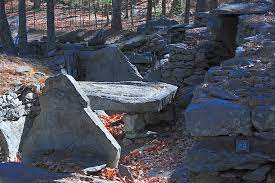
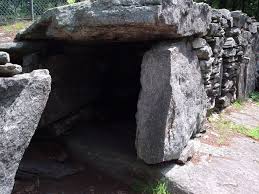
In Salem, New Hampshire, you can find a place called American Stonehenge, also known as mystery hill. In this 30-acre stretch of woods, you can find scattered rocks, huts made from stone, stone walls, caves, and a stone slab. It is strange to see when it’s usually a heavily wooded area. The site has been known since the 1700s; however, in 1937, it caught the eyes of William Goodwin, who purchased the land. Since then, the site has become a tourist attraction and an archaeological site.
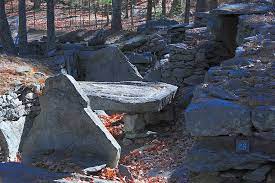
Since this is a tourist attraction, anyone can go and see the site for 13 dollars a person. One of the most noted stops is the stone slab which is also known as the sacrificial stone. Some think that the stone was used for human sacrifice, and the groves in the rock were to help blood drain. However, the stone slab most likely used the leach lye to make soap.
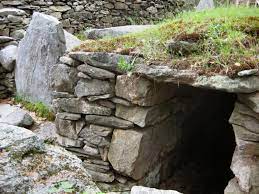
It is highly debated what these stones and structures are. Some believe they are of the pre-Columbian origin or from native Americans while others think they’re leftovers from farmers in 1800-1900. These seem to be the most accepted of the theories. While William Goodwin strongly considers that the site is proof of Irish monks living there long before anyone else “found North America.” Unfortunately, Goodwin moved stones and structures to fit his narrative. This means his Irish monk theory is almost sure to be wrong.
One significant finding of the site is the charcoal. Some of this charcoal was radio-carbon dated to over 4000 years old. This means there is good evidence that humans occupied the area 4000 years ago. Other significant finds include a native American Wigwam, a 300-year-old canoe, and fire pits dating back to 2000 years ago.
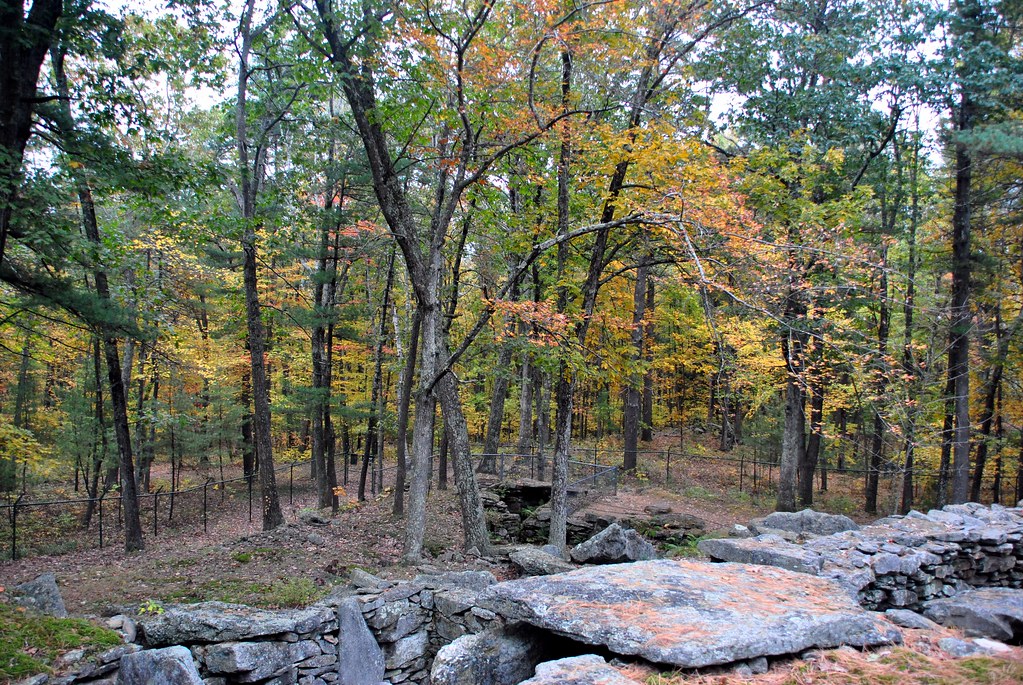
No one will know how the stones nor site came to be, but some things are known for sure. It has been documented as a quarry and homestead, and Native Americans have lived there.




 northamericanmysteries.com
Leave a comment