
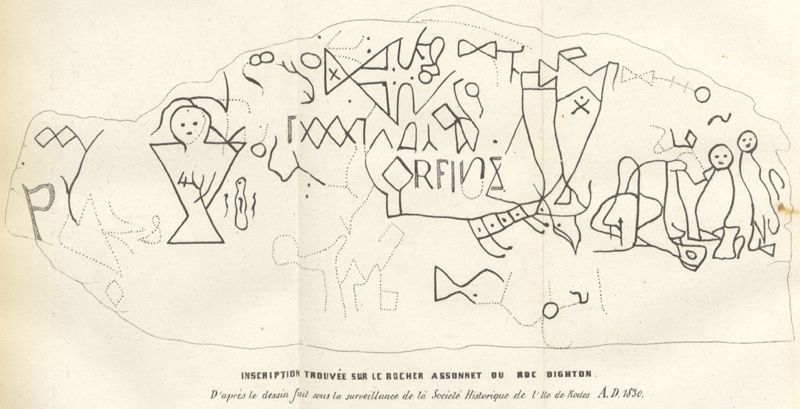
Since time immemorial, humans have been leaving their mark on the world, not just through their actions but also through more tangible means, like carvings and etchings on rock surfaces. One such enigmatic artifact that has puzzled historians and archaeologists for centuries is the Dighton Rock, an 11-foot high, 40-ton boulder located in Berkley, Massachusetts.
The first recorded observation of the Dighton Rock dates back to 1680 when it was described by Reverend John Danforth. It was partially submerged in the Taunton River, showing only a portion of its cryptic inscriptions at low tide. In 1963, to preserve the rock and its etchings, it was moved to its current location at Dighton Rock State Park. The rock is now housed in a museum designed specifically for its display and protection.
What makes the Dighton Rock particularly intriguing are the petroglyphs etched into its surface. The rock features a complex array of glyphs, lines, and images, and over the years, the markings have sparked numerous theories about their origins.
Some of the early interpretations suggested that the rock’s inscriptions were the work of Native American tribes, such as the Wampanoag people. This theory was backed by early colonial settlers and remains one of the most accepted explanations today.
Yet, the Dighton Rock has also given rise to several alternative theories, some of which postulate that the inscriptions were created by ancient Phoenicians, Norse explorers, or even Portuguese explorer Miguel Corte-Real. Each theory is based on different interpretations of the symbols and the historical possibilities of trans-oceanic contact.
Modern scientific research and technology have allowed for more detailed investigations of the rock. In the 19th century, antiquarian and Harvard professor, Edmund B. Delabarre, conducted extensive studies on Dighton Rock, proposing the theory that the carvings were made by early Portuguese explorers.
In recent years, digital imaging and 3D scanning technologies have been employed to record the inscriptions in detail, which has resulted in more nuanced interpretations of the symbols. Still, no definitive conclusion has been reached about the rock’s inscriptions.
Despite the lack of consensus about the origins of the Dighton Rock inscriptions, the stone remains a significant artifact that fuels curiosity and speculation. Its mysterious etchings provide a tantalizing glimpse into the past, representing either indigenous artistry or potential evidence of early trans-oceanic exploration.
Until the riddle of its creation is solved definitively, Dighton Rock continues to be a captivating symbol of human history’s enduring mysteries, a testament to the complexity of our shared past and the enigmatic narratives it carries.




 northamericanmysteries.com
Leave a comment