
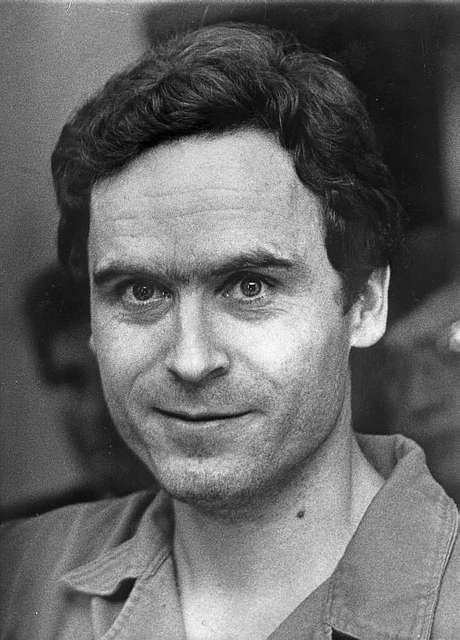
Ted Bundy remains one of the most notorious and chilling figures in criminal history. His charismatic demeanor, combined with his heinous crimes, baffled law enforcement and captivated the public’s imagination. From his enigmatic birth to his eventual demise, Bundy’s life is a tale of deception, manipulation, and unrelenting violence that shook the very foundations of society.
I. Early Life and Childhood
Theodore Robert Bundy was born on November 24, 1946, in Burlington, Vermont, to Eleanor Louise Cowell. His true paternity remains a subject of speculation and mystery. Bundy grew up believing that his grandparents, Samuel and Eleanor Cowell, were his parents and that his biological mother was his sister. This distorted family dynamic possibly contributed to Bundy’s distorted view of relationships and women.
Despite his seemingly normal upbringing, Bundy exhibited early signs of trouble. He displayed an intense interest in violence and death, often lurking around hospitals and morgues. His fascination with knives also raised concerns among those who knew him. Bundy’s penchant for cruelty hinted at a disturbed psyche that would ultimately shape his future.
II. College Years and Emergence of a Killer
Bundy’s intelligence and charm propelled him to college, where he excelled academically and socially. During this time, he began to date and build relationships, though he often manipulated those around him. His charismatic façade masked a darker truth – Bundy was harboring violent fantasies and began to act upon them.
Ted Bundy’s crimes were marked by extreme violence and manipulation. He is known to have committed a series of gruesome murders, often targeting young women who resembled one another. While he confessed to some of these crimes, the exact number of his victims remains uncertain. Here are some of the known cases:
- Donna Gail Manson and Susan Elaine Rancourt: In 1974, Bundy is believed to have abducted and murdered 19-year-old Donna Gail Manson and 18-year-old Susan Elaine Rancourt in Washington. Their disappearances and later discoveries of their remains were among the early signs that a serial killer was at large.
- Lynda Ann Healy: Bundy’s first known murder victim was Lynda Ann Healy, a 21-year-old student at the University of Washington. She vanished from her apartment in 1974. Bundy later admitted to her murder and claimed to have revisited her body multiple times.
- Brenda Carol Ball: In the same year, 22-year-old Brenda Carol Ball disappeared from a tavern in Washington. Her skeletal remains were found on a mountain a year later. Bundy hinted at his involvement in her death but didn’t provide explicit details.
- Georgeann Hawkins: Another University of Washington student, 18-year-old Georgeann Hawkins, went missing in 1974. Bundy confessed to her murder and indicated that he had lured her to his car under the pretense of needing help with a boat.
- Janice Anne Ott and Denise Marie Naslund: On July 14, 1974, Bundy approached Lake Sammamish State Park in Washington and successfully lured 23-year-old Janice Anne Ott and 19-year-old Denise Marie Naslund to his car by pretending to need assistance with unloading his sailboat. Both women disappeared that day, and their remains were later discovered in a remote area.
- Caryn Campbell: Bundy’s killing spree extended to Colorado in 1975, where he murdered 23-year-old Caryn Campbell. She was on vacation in Aspen when she vanished. Her remains were found in a nearby forest.
- Debra Kent: Bundy confessed to the 1974 abduction of 17-year-old Debra Kent from a Utah high school. Despite extensive searches, her body was never located.
- Margaret Bowman: In 1975, Bundy abducted and murdered 21-year-old Margaret Bowman in Colorado. Her remains were found in the mountains.
These cases represent just a portion of Bundy’s known victims. His methods often involved gaining the trust of his victims by feigning injuries or asking for help, only to subdue and then abduct them. His charming demeanor and seemingly harmless requests masked his true intentions, making him a truly terrifying and manipulative figure.
In 1974, women began disappearing in the Pacific Northwest. Bundy’s resemblance to the composite sketches of the suspect led to mounting suspicion. As evidence mounted, Bundy’s double life unraveled. He was arrested and convicted for the attempted kidnapping of Carol DaRonch, an incident that exposed his dangerous inclinations.
III. The Trial and Escape
Bundy’s trial in 1976 captured the nation’s attention. His charm and charisma were on full display as he represented himself, garnering a cult-like following of admirers. Despite the overwhelming evidence against him, Bundy’s ability to manipulate the courtroom environment prolonged the trial. He was eventually convicted of murder and sentenced to prison.
In 1977, Bundy made a daring escape from custody, exploiting weaknesses in the prison’s security. During his escape, he committed more murders, further solidifying his reputation as a ruthless serial killer. A nationwide manhunt ensued, and Bundy’s cunning allowed him to evade capture for months.
IV. Recapture and Trials
Bundy’s escape came to an end in 1978 when he was captured in Florida. His subsequent trials showcased the lengths to which he would go to control his narrative. Bundy’s defense tactics, including firing his legal team and using the courtroom as a stage for his theatrics, added to the spectacle of his trial. He was ultimately found guilty of multiple murders and received the death penalty.
V. Legacy and Execution
Ted Bundy’s execution in the electric chair on January 24, 1989, marked the end of a chapter in American criminal history. His legacy endures not only for his gruesome crimes but also for the insights his case provided into the psychology of serial killers. Bundy’s ability to charm, manipulate, and deceive shed light on the complexities of human behavior and the dangers of underestimating those who possess such traits.
Conclusion
The life of Ted Bundy is a harrowing tale of a man who traversed the fine line between charm and brutality. From his enigmatic birth to his chilling reign of terror and eventual execution, Bundy’s story serves as a stark reminder of the capacity for evil that can lurk behind even the most charming façades. Understanding his life and crimes offers valuable insights into the intricate interplay between nature and nurture in the development of a monster.



 northamericanmysteries.com
Leave a comment